
.png)


Aspartech CLEAR-COAT
Decorative, Clear, Protective Floor Coating
.png)
Product Description
Aspartech CLEARCOAT is a two component, high performance clear floor coating formulated using pioneering, polyaspartic technology.
Aspartech CLEARCOAT is low viscosity, rapid curing and has excellent levelling characteristics making it ideal for use in commercial and warehouse flooring applications. Aspartech CLEARCOAT does not contain solvents, is zero VOC and has the added benefits of excellent chemical resistance with low temperature cure properties

The durable, hardwearing coating requires minimal maintenance and is easy to keep clean. Aspartech CLEARCOAT provides a good level of slip resistance and outperforms traditional systems in abrasion resistance, hardness, and adhesion.
Attributes & Benefits
❶ High Performance
Hard surface with high chemical, abrasion, and UV resistance.
❷ Rapid cure
Fast cure profile reduces downtime allowing quick return to service.
❸ Unlimited Aesthetic Options
Can be used with flakes or glitter for desired appearance.
❹ Solvent Free
Does not contain hazardous, flammable solvents or fillers.
❺ Zero VOC’s
Zero VOC and low odour formulation.
Technical Performance
Industrial floor coatings are expected to do far more than simply provide an attractive finish. They must withstand heavy traffic, resist wear, bond securely to the substrate and continue performing in demanding environments for many years. Aspartech CLEARCOAT has been tested against recognised British, European and ASTM standards to demonstrate its outstanding mechanical, chemical and environmental performance.

Sustainable by Design
Modern construction projects increasingly demand products that contribute towards sustainable building certifications. Aspartech CLEARCOAT has been formulated with environmental performance in mind and offers:
-
Zero VOC formulation with a product VOC content of less than 10 g/L.
-
Compliance with LEED EQ Credit 4.1 for low-emitting materials.
-
Compliance with BREEAM requirements for volatile organic compounds.
-
Manufactured in accordance with EN 13999:2013 VOC testing requirements.
These characteristics make Aspartech CLEARCOAT an excellent choice for projects where indoor air quality, occupant wellbeing and environmental compliance are key considerations.
Aspartech Long-Term Performance
By combining exceptional adhesion, high surface hardness, excellent abrasion resistance, outstanding UV stability and a Zero VOC formulation, Aspartech CLEARCOAT delivers the performance expected of a premium industrial and commercial floor coating. Whether used in warehouses, healthcare facilities, food production areas, laboratories or commercial premises, it provides a durable, attractive and long-lasting finish designed to perform in the most demanding environments.
Chemical Resistance
Industrial and commercial floors are often exposed to a wide variety of chemicals during normal use, from routine cleaning products through to fuels, oils and aggressive industrial substances. A floor coating must be capable of withstanding these exposures without softening, staining or degrading if it is to provide long-term protection.
Aspartech CLEARCOAT has been formulated to provide excellent resistance to many of the chemicals commonly encountered in warehouses, workshops, manufacturing facilities, laboratories, healthcare environments and food production areas. This helps maintain both the appearance and integrity of the floor while reducing maintenance costs and extending the service life of the coating.
The table below summarises the performance of Aspartech CLEARCOAT following 1 hour and 24 hour exposure to a range of commonly encountered chemicals.

Aggressive Chemicals
While Aspartech CLEARCOAT offers outstanding resistance to a broad range of chemicals, prolonged contact with highly aggressive substances should always be avoided where possible.
Testing showed that:
-
DOT 4 synthetic brake fluid caused surface etching after 24 hours of continuous exposure.
-
Hydrochloric acid also caused surface etching after 24 hours of continuous exposure.
Importantly, neither chemical caused visible damage after a 1-hour exposure period, demonstrating that accidental spills can generally be cleaned before any permanent effect occurs.
Good Housekeeping Practice
Although Aspartech CLEARCOAT provides excellent chemical resistance, good housekeeping remains essential. Chemical spills should always be cleaned as soon as practical, particularly aggressive acids, brake fluids and other reactive substances. Prompt removal not only protects the coating but also helps maintain a safe working environment and reduces slip hazards.
Under normal operating conditions, Aspartech CLEARCOAT provides a durable, hygienic and highly chemical-resistant finish that is well suited to demanding commercial and industrial environments where regular cleaning and occasional chemical exposure are expected.
Application Instructions
Proper mixing is critical in the successful application of Aspartech ClearCoat. The system is supplied in two, pre-weighed components which contain the correct ratio of material for the kit. Part ‘A’ is commonly referred to as the ‘Resin’ and part ‘B’ as the ‘Hardner’.
The mix ratio for Aspartech ClearCoat is 60% part ‘A’ with 40% part ‘B’. Part ‘A’ is supplied in a plastic bucket and part ‘B’ is supplied in a plastic bottle.

❶ Ensure you have the correct number of part ‘As’ and Bs’ and the containers are sealed and undamaged. Create a defined mixing area using a tarpaulin to protect the surface of the mixing area from spills and splashes. Avoid storing the product or mixing in direct sunlight as this can increase the products temperature and rate of cure.
❷ Remove the lid from part ‘A’ and mix for 60 seconds using a drill mixer at a low-speed setting and a helix mixing paddle. Slow speed/high torque mixing is essential to prevent the formation of trapped air bubbles.
If Aspartech ClearCoat is being used as a clear (non-filled) coating to enhance the gloss appearance or increase the strength of an existing surface, then the next section (Flakes & Glitter) is not applicable, and you should move to step 3 of the mixing instructions.
Flakes & Glitter
Any decorative appearance additions such as vinyl acrylic flakes or metallic foil glitters can be broadcast onto the applied resin or mixed into the ‘A’ component prior to the addition of the ‘B’ component. The amount of flake or glitter is dependent on the desired appearance. The following table shows the estimated addition level per 5kg kit of Aspartech ClearCoat.
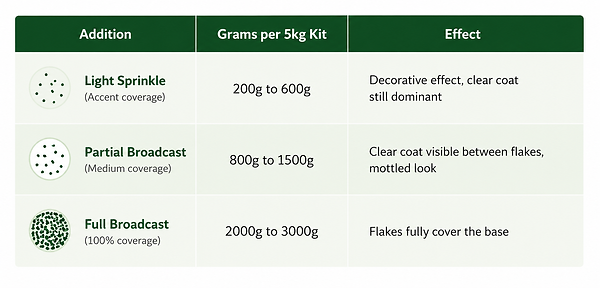
The total addition is ultimately dependant on the desired appearance and a trial mix should always be performed prior to deciding the total flake addition of each kit however a general ‘rule-of-thumb’ is that for a light accent the addition is approximately 0.5kg flakes per 5kg of resin, medium coverage requires approximately 1kg of flakes per 5kg of resin and full coverage requires approximately 2.5kg flakes per 5kg of resin.
❸ Remove the lid from part ‘B’ and carefully pour the contents into the bucket containing the premixed part ‘A’. Squeeze the bottle to ensure as much of the part ‘B’ is added to the bucket as possible and do not replace the lid.
❹ Submerge the mixer head into the resin and start to mix on a medium speed for 60 seconds. In colder temperatures (<10°C) the viscosity of the product can increase, and it may be necessary to mix for 90 seconds. Whilst mixing, move the mixer head around the bucket, scraping the sides and bottom. Avoid mixing at an excessive speed as this can result in splashing and whipping air into the mixture.

❺ After mixing is complete, let the product stand for 60 seconds to allow any trapped air to escape. Pour the mixed resin onto the application substrate.
The mixed components have a pot-life of between 20 and 30 minutes. Warmer temperatures (>25°C) can reduce the pot life. Mixed resin should not be allowed to stand in the bucket for a prolonged period as the volume of the material allows for heat build-up (exothermic reaction) which can significantly speed up the rate of cure and result in roller/squeegee indentations on the cured surface.
❻ As soon as the mixed resin is poured onto the application area, use a serrated squeegee or trowel to spread the resin over the application area. Work in predefined sections to ensure the correct application depth and avoid uneven curing. Always keep a wet edge which will prevent trowel squeegee marks. Use a spiked roller to remove any imperfections and trapped air bubbles and ensure a uniform finish.
❼ Equipment such as the mixer blade, trowels, brushes, squeegees, and rollers should be cleaned at regular intervals using Aspartech SOL-ZERO and then dried using a clean rag or fabric cloth.
Cure Time
One of the key advantages of Aspartech CLEARCOAT is its exceptionally rapid cure profile. Developed using advanced resin technology, the coating has been engineered to minimise downtime while delivering outstanding mechanical performance and long-term durability. Unlike conventional epoxy floor coatings that can require several days before returning an area to service, Aspartech CLEARCOAT progresses quickly from application to full cure, allowing projects to be completed faster and reducing disruption to normal operations.
Following correct mixing and application, the coating develops in a series of predictable stages:


Fast Return to Service
Under normal application temperatures of 15°C to 25°C, Aspartech CLEARCOAT can typically be:
-
Tack free & recoated in just 2 hours
-
Walked on after around 3 hours
-
Returned to heavy service after 24 hours
-
Fully chemically resistant within 7 days
This rapid cure profile makes Aspartech CLEARCOAT particularly well suited to warehouses, manufacturing facilities, food production areas, healthcare environments, retail premises and commercial buildings where downtime must be kept to an absolute minimum.

Important Guidance
The cure times shown are intended as a guide only. Actual curing performance will vary depending on substrate temperature, ambient temperature, relative humidity, coating thickness and site ventilation.
Cold concrete substrates can significantly extend cure times, even where the air temperature appears suitable, while warmer conditions will generally accelerate the curing process.
For the best balance of application time, finish quality and curing performance, Aspartech CLEARCOAT should ideally be applied at 17°C onto a clean, dry and suitably prepared substrate.
Coverage Rate
The recommended application thickness of Aspartech CLEARCOAT depends on the intended service conditions and the condition of the substrate.
● Light foot traffic: Minimum dry film thickness of 0.7 mm
● General commercial and industrial use: Minimum dry film thickness of 1.0 mm
● High wear or heavily trafficked areas: Minimum dry film thickness of 1.2 mm
Coverage rates are dependent upon the specified application thickness together with the texture and porosity of the substrate. Smooth, well-prepared concrete will provide the highest coverage, whereas textured or porous substrates will naturally require more material to achieve the same film build.
Typical Coverage Rates (at 0.7 mm minimum film thickness):
Aspartech CLEARCOAT 5kg: Smooth surface=6.7m² Textured surface=6.0m² Porous surface=5.5m²
Theoretical Coverage on Smooth Surfaces
For suitably prepared, smooth substrates, the theoretical coverage is determined primarily by the application thickness:
Aspartech CLEARCOAT 5kg: 0.7mm=6.71m² 1.0mm=4.70m² 1.2mm=3.91m²
The figures above are theoretical values based on the mixed density of the product and assume application to a smooth, non-porous substrate. Actual coverage will vary depending on substrate profile, surface porosity, wastage and application method.
Product Storage
Aspartech CLEARCOAT contains isocyanates and the advice contained in the products Safety Data Sheet (SDS) is of particular importance.
Good standards of industrial hygiene should be observed when handling this product. Protective gloves and goggles should be worn when handling the containers. The recommendations made in the Health and Safety data sheet for this product should always be observed.

.png)