
.png)


Aspartech SPECTRUM
Colour Addatives
.png)
Product Description
Aspartech PRIME is a two-component, high-performance, clear primer formulated using advanced polyaspartic technology and designed specifically for use beneath Aspartech resin flooring systems.
Its low-viscosity formulation provides excellent wetting and penetration into concrete and other suitably prepared mineral substrates, helping to consolidate the surface, reduce porosity and create a strong, reliable bond between the substrate and subsequent Aspartech coatings.

Unlike conventional slower-curing resin primers, Aspartech PRIME has been developed for rapid installation. At typical application temperatures of 10–20°C, it becomes tack-free in approximately 30 minutes and can be overcoated after approximately 90 minutes, helping to significantly reduce installation times and minimise disruption.
Aspartech PRIME is solvent-free, 100% solids and Zero VOC. Its clear formulation provides excellent adhesion without introducing unnecessary solvents or volatile emissions into the working environment.
Suitable for internal and external applications, Aspartech PRIME can be used on correctly prepared concrete, cementitious screeds and other compatible mineral substrates before the application of Aspartech flooring and protective coating systems.
Attributes & Benefits
❶ High Performance
Excellent adhesion and substrate wetting, providing a strong interface between prepared concrete and subsequent Aspartech coatings.
❷ Rapid cure
Fast cure technology enables rapid overcoating, reducing installation time and allowing flooring systems to be completed sooner.
❸ Excellent Penetration
Low-viscosity formulation penetrates porous concrete and cementitious substrates, to consolidate the surface and reduce porosity.
❹ Full System Compatibility
Developed specifically as the primer for Aspartech flooring systems, including Aspartech FLOORCOAT, CLEANZONE & CLEARCOAT.
❺ 100% Solids / Zero VOC’s
Solvent-free, 100% solids formulation with Zero VOC emissions.
Typical Applications
Aspartech PRIME is suitable for priming prepared mineral substrates in a wide range of industrial, commercial and institutional environments, including:
-
Industrial production facilities
-
Warehouses and distribution centres
-
Food processing facilities
-
Pharmaceutical facilities
-
Hospitals and healthcare environments
-
Workshops and garages
-
Schools and universities
-
Commercial buildings
-
Laboratories
-
Retail premises
-
Showrooms
Chemical Resistance
Aspartech PRIME provides excellent resistance to a broad range of chemicals and contaminants commonly encountered in industrial and commercial environments. Testing demonstrates resistance to fuels, oils, cleaning agents, disinfectants, solvents and alkaline substances.
Following 24 hours' exposure, no damage or discolouration was observed with anti-freeze/coolant, undiluted washing detergent, diluted benzyl alcohol, alcohol-based disinfectant, concentrated sugar soap, moss killer, methylated spirits, superwarm fuel, glass cleaner, white spirit, stainless-steel and oven cleaner, thick bleach, Castor Oil, disinfectant, caustic soda, diesel or petrol.
Synthetic brake fluid (DOT 4) and hydrochloric acid produced surface etching following prolonged 24-hour exposure.

Chemical resistance can be affected by concentration, temperature, exposure duration and service conditions. Site-specific testing is recommended where prolonged or unusual chemical exposure is anticipated.
Application Instructions
Correct mixing is essential to the performance of Aspartech PRIME. The product is supplied as two pre-weighed components in the exact proportions required for a complete kit.
A 5kg kit consists of:
Part ‘A’: 3.480 kg – 69.6%
Part ‘B’: 1.520 kg – 30.4%
Do not alter the mixing ratio or split kits unless the individual components can be accurately weighed to the specified ratio.
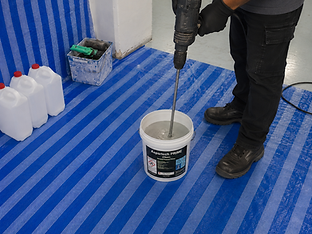
❶ Preparation
Ensure the correct Part ‘A’ and Part ‘B’ components are available and that all containers are sealed and undamaged. Establish a clean, protected mixing area. Avoid storing or mixing the product in direct sunlight or close to heat sources, as increased material temperature will accelerate the reaction and reduce working time.
❷ Premix Part ‘A’
Remove the lid from Part ‘A’ and mix for approximately 60 seconds using a suitable low-speed mixer fitted with a helix mixing paddle.
❸ Add Part ‘B’
Pour the complete contents of Part ‘B’ into the Part ‘A’ container, ensuring as much material as practical is transferred.
❹ Mix Components
Mix thoroughly for approximately 60 seconds, moving the paddle around the container and across the bottom and sides to ensure a homogeneous mixture.
At temperatures below 10°C, viscosity will increase and additional mixing time may be required.
Avoid excessive mixing speeds, which can introduce air into the material.
❺ Apply Immediately
Once mixing is complete, immediately transfer the material to a roller tray or distribute it directly onto the prepared substrate.
Do not leave mixed Aspartech PRIME standing in the mixing container, as the concentrated mass can generate heat and significantly reduce usable working time.
❻ Apply the Primer
Immediately distribute the mixed Aspartech PRIME over the prepared substrate using a low-pile roller, brush or suitable rubber squeegee followed by back-rolling.
Apply as a thin, continuous and uniform film, working the primer thoroughly into the substrate to maximise wetting and penetration.
Ensure that no dry or untreated areas remain. Avoid excessive build-up or ponding of material, as unnecessarily high film thickness can adversely affect curing and subsequent coating application.
Highly porous or absorbent substrates may require an additional application to achieve complete and uniform sealing.
❼ Equipment Cleaning
Tools and application equipment should be cleaned before the material has cured using the recommended Aspartech cleaning solvent. Once cured, the material will generally require mechanical removal.
Cure Time
Aspartech PRIME uses rapid-curing polyaspartic technology, allowing subsequent coatings to be applied considerably sooner than with many conventional resin primers.
Temperature has a significant effect on cure rate. Lower temperatures increase cure times, while higher temperatures accelerate the reaction and reduce both cure and working times.

The product can be applied between -10°C and +25°C. At temperatures below 5°C, cure times will be longer than those shown above and should be confirmed under actual site conditions.
The stated times are typical laboratory/application values and may be influenced by substrate temperature, material temperature, film thickness and environmental conditions.
Important Guidance
The cure times shown are intended as a guide only. Actual curing performance will vary depending on substrate temperature, ambient temperature, relative humidity, coating thickness and site ventilation.
Cold concrete substrates can significantly extend cure times, even where the air temperature appears suitable, while warmer conditions will generally accelerate the curing process.
Coverage Rate
Coverage rates are dependent upon the texture and porosity of the substrate. Smooth, well-prepared concrete will provide the highest coverage, whereas textured or porous substrates will naturally require more material to achieve the same film build.
Typical Coverage Rates:
Aspartech PRIME 5kg: Smooth surface=7.5m² Textured surface=6.5m² Porous surface=6.25m²
Actual coverage will vary according to surface profile, porosity, substrate condition, application technique and material losses.
Highly porous substrates will absorb a greater quantity of primer and may require a second application to achieve complete sealing. The stated coverage rates should therefore be treated as guidance, and a representative site trial is recommended where accurate material consumption needs to be established.
Product Storage
Aspartech PRIME contains isocyanates and the advice contained in the products Safety Data Sheet (SDS) is of particular importance.
Good standards of industrial hygiene should be observed when handling this product. Protective gloves and goggles should be worn when handling the containers. The recommendations made in the Health and Safety data sheet for this product should always be observed.

.png)